

Ambidextrous Leadership: What 136,545 Talent Assessments Reveal

In an environment of growing complexity, managerial intuition has expired. This is what Talent Decoded 2026, the People Experts study analyzing 136,545 professional assessments — 53.51% men and 46.49% women — demonstrates as it seeks to answer a question that goes far beyond gender quotas: what combination of talent truly builds successful organizations?
According to the report, the answer is not about choosing between male or female profiles, but about integrating them. Welcome to the concept of Ambidextrous Leadership.

The science behind the data
The study combines three layers of analysis under a Deep Data methodology:
PRISM@ - Personality: an ipsative, forced-choice methodology that removes “social desirability bias” and reveals the real person.
CML - Motivations: distinguishes between what talent can do and what talent wants to do.
VIPS/NIPS - Aptitudes: maximum-performance tests designed to assess senior leadership capabilities.
This threefold perspective makes it possible to move beyond stereotypes and base talent decisions on evidence rather than perceptions.
Execution vs. power: the myth of a lack of ambition
The data dismantles a widespread belief in the corporate world. Female talent outperforms male talent in Constancy — 5.80 versus 5.31 — and in Goal Ambition — 5.42 versus 5.28. Women sustain long-term effort, and their ambition is just as real as men’s.
Men, meanwhile, stand out in Decisiveness — 5.71 versus 5.37. They are faster off the mark.
The result is a map of complementary roles:
Male profile — “The Kick-off”: ideal for an aggressive go-to-market strategy.
Female profile — “The Finisher”: ideal for long, sustained implementations.
The analytical gap: an upskilling alert, not biology
There is a critical difference in Numerical Reasoning — NIPS: 8.23 for men versus 7.06 for women, a gap of +1.16 points. The report is clear about its origin: it reflects historical professional exposure, including lower representation in STEM careers, not a biological difference.
The recommendation is equally clear: selection processes based solely on numerical tests risk eliminating valuable talent. The smart strategy is to use NIPS to identify “hidden gems” and invest in data literacy programs for female leadership.
The hidden cost of high performance
One of the study’s most revealing findings relates to wellbeing. Women show an Internal Tension score of 6.36 versus 5.87 for men, while at the same time reporting a higher Positive Attitude — 5.89 versus 5.50.
The report calls this pattern “Anxious Resilience”: a facade of optimism that coexists with a severe internal burden. The operational conclusion is clear: there is a high risk of silent burnout among top performers, and organizations should treat internal tension as a business indicator, not merely an HR concern.
The new ROI: ethics and empathy as hard assets
In the field of social skills, the empathy gap is clearly in favor of women — 5.99 versus 4.93 — while men score somewhat higher in Willingness to Command. The report argues that, in today’s “experience economy,” female empathy functions as a true hard skill for customer retention, while male directiveness is key in crisis management.
When it comes to motivations — CML — the number one driver for both genders is Training and Development. But the nuances matter: women prioritize Ethics and Values — 6.86 — and seek purpose and alignment; men prioritize Power and Command, with a +0.58 gap, and place greater value on autonomy and status. The retention strategy, therefore, is not one-size-fits-all: “career and purpose” for women, “autonomy and bonus” for men.
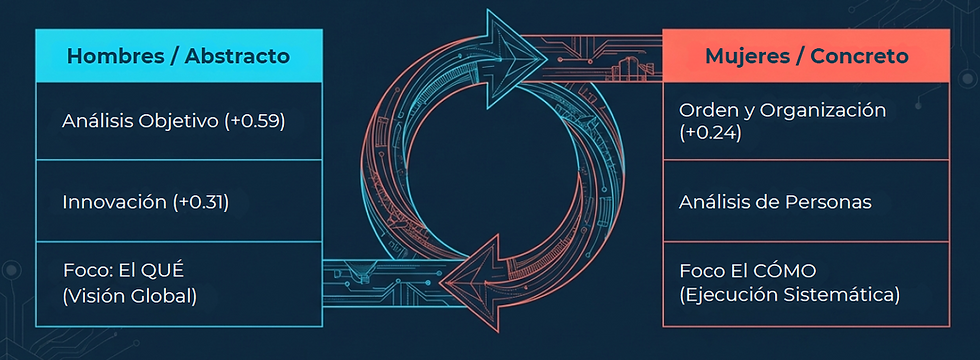
Cognitive diversity: the vaccine against error
The study describes two clearly differentiated cognitive styles:
Men / Abstract: objective analysis +0.59, innovation +0.31, focus on the what — big-picture vision.
Women / Concrete: order and organization +0.24, people analysis, focus on the how — systematic execution.
An all-male team sees the opportunity but may fail in the process. An all-female team perfects the process but may limit disruption. Cognitive diversity, the report concludes, is the vaccine against error.
From theory to operations: two real cases
The report brings these findings down to earth in key sectors for the region:
Logistics Hub 2026: the Control Tower and Compliance function requires order and constancy — a female profile — while freight negotiation in times of crisis demands risk analysis and fast decision-making — a male profile. Operational excellence requires mixed teams at every link in the chain.
Banking and Fintech: risk and ethics committees are strengthened by integrating the female profile to prevent reputational disasters, while product innovation benefits from the male profile, channeled through the female profile’s systematic approach to quality control.
The roadmap: from diagnosis to the ambidextrous team
Talent Decoded 2026 closes with three concrete lines of action for organizations:
Lead with purpose: move from “command” to “development” as the only real path to retaining female and young talent.
Audit wellbeing: treat internal tension as a financial KPI, with mental health and psychosocial risk audits.
Engineer teams: design “ambidextrous teams” in which every innovator has an executor, and every analyst has an empathetic profile.
Conclusion
The central message of the study is as simple as it is powerful: a monochrome team is an incomplete brain. Organizations’ competitive advantage does not lie in choosing between the male analytical hemisphere and the female executive hemisphere, but in building the architecture that allows both to work together.
Do you want to know how to apply these findings to your organization? At People Experts, we help design high-performance teams based on data, not intuition.


Comments